



-- The Karelian Research Centre had a very curious foundation history. The official founding date is indeed January 31, 1946. This was the day when the Presidium of the USSR Academy of Sciences discussed the establishment of the USSR AS Research Facility in the Karelian-Finnish SSR, approved its structure and management.
However, there were many events that preceded that day. Long before, back in 1930, the Karelian Integrated Research Institute (KIRI) was established by a decision of the Council of People's Commissars of the Autonomous Karelian Soviet Socialist Republic. Interestingly, its first director was the then-head of Karelia, Edvard Gylling, PhD. The institute comprised six sections of different profiles. Soon, however, this institute was transformed into the Karelian Research Institute of Culture, which significantly narrowed the scope of scientific research in Karelia.
Therefore, the decision taken on January 31, 1946, was anticipated, logical, and necessary for the republic. The country was going through hard times, yet the decision to establish a scientific organization was made. Naturally, there was a shortage of local personnel, so a brilliant assemblage of scientists arrived from outside. A prominent scientist, specialist in geology and petrography, Academician Alexander Polkanov became the Director of the USSR AS Research Facility. By the end of 1946, the staff of the Karelian-Finnish Facility of the USSR Academy of Sciences numbered 59 researchers, including 5 Doctors and 14 Candidates of Sciences.
To truly appreciate the significance of this event, one must realize that the 1940s were harsh both for the country as a whole and for Karelia. Archival documents show that despite shortages of virtually everything, with food ration cards still in use, the leadership of the country and the republic understood that progress was impossible without science. That is why corporate apartments were allocated, and vehicles were acquired. We were given our first building, which is still ours, situated on 50 Nevsky Avenue. This is the legacy that we cherish, value, and maintain.

Academician of the USSR AS A.A. Polkanov
-- How has the Centre changed over these years, and what is the Karelian Research Centre of the Russian Academy of Sciences like today?
-- Since its foundation, the research center has changed its name and structure multiple times, and in 2017 it was reorganized into the Federal Research Centre "Karelian Research Centre of the Russian Academy of Sciences". From the very start, in 1946, a number of research directions have been taken on, including water resources, geology, and forestry. These were the starting points for the development of our scientific research. Many transformations have happened since then – sections and departments gradually evolved into scientific institutes.
Over time, there emerged the Institute of Biology, Forest Research Institute, Institute of Geology, Northern Water Problems Institute, and Institute of Applied Mathematical Research. Also, the Karelian Research Centre currently encompasses the Institute of Economics, and our oldest institute, essentially founded back in the 1930s – the Institute of Linguistics, Literature and History, which studies our region’s cultural heritage. In recent years, we have established the Department for Multidisciplinary Research, whose task is to promote interdisciplinary studies within our centre. Thus, the KarRC RAS today comprises these eight scientific subdivisions.

Building of the Karelian-Finnish Research Facility of the USSR Academy of Sciences in Uritsky street (now renamed as Al.Nevsky St.). Year 1946
-- No doubt, the main asset of the KarRC RAS is people, scientists. Who are they? Is there more of young specialists or seasoned professionals?
-- In order to advance, science needs mentors – merited individuals who have done a lot to promote it and understand how science is made and how discoveries are reached. On the other hand, without recruitment of the youth, young specialists, it is impossible to move forward. At present, the Centre is a team of 800 employees, and 40 percent of its research staff are young scientists. It is crucial for young researchers to know that their work is needed, that they are at par globally, that they can do a great deal for our region and country. To achieve this, the facilities must be kept up to date, modern equipment must be available, and salaries must be decent. This makes youth recruitment for the center challenging yet indispensable.
-- How high are the qualifications of Karelian scientists?
-- Putting aside false modesty, we can definitely say that our scientists’ work meets high standards not only for Russia but also internationally, or, as we commonly say in our community, at the world level. There is a specific way to assess of our activities, which is expert evaluation by other scientists. We publish many of our scientific papers in international journals, where the selection process is very rigorous and getting through is not easy, because high-ranking scientific journals only publish truly "breakthrough" work. So, the fact of such publications confirms that our research is up to high professional standards. Furthermore, our founder – the Ministry of Science and Higher Education of Russia – periodically evaluates its subordinate scientific organizations. These assessments regularly confirm our top status as a scientific center, being placed in category one. Specialists from various fields are involved in the assessments, including representatives of the Russian Academy of Sciences – leading experts in different scientific areas.
-- Can you give some examples of applied, practical outputs of these studies?
-- We can mention, for example, the work of scientists at the Institute of Geology. Our geologists have been studying the region's mineral resources for many years; a number of deposits have been discovered, and the results of their study have been presented to the republic so that mining operations could be launched.
One of the most vivid cases is the discovery of the iron ore deposit in the Kostomuksha area. This discovery was made decades ago, but since the mill was commissioned in 1982, exploration of the deposit continued with more reserves discovered, and our geologists contribute to this work.
-- Environmental issues are of special relevance today. What does the KarRC RAS do in this sphere?
-- Also there, in Kostomuksha, our specialists continuously monitor the environmental impact of the mining enterprise and answer the questions coming from the company management. We also work with our pulp and paper mills, assessing the environmental situation. For example, we collaborate with the Kondopoga Pulp and Paper Mill on waste management issues, considering they produce a lot of wastes. Currently, our scientists are conducting experiments together with the Kondopoga mill, and there are some ideas and developments regarding the use of wastes.
We are actively researching our largest lakes – Ladoga and Onego, the White Sea, small lakes, and groundwater. Very interesting results have been obtained regarding the springs of the Martial Waters spa resort. This work is crucial because Lakes Ladoga and Onego are sources of drinking water not only for Karelia but, in fact, also for the St. Petersburg population.
What makes these studies unique is that they have been conducted systematically for over 60 years. Annual expeditions provide us with high-precision data. There are hot points that we identify and for which we propose solutions.
-- How do you communicate with the authorities – republican and federal?
-- We are in close contact with the republican authorities, participating in many councils operating under the Head of the Republic and under various ministries. We try to relate our developments as much and as thoroughly as possible, e.g. through memos, presentations, or reports. Our data have been used a lot in decision-making at the republican and local levels.
As for federal authorities, the materials we produce are certainly delivered to the Ministry of Science and Higher Education, but we also build relationships with other ministries. For example, with the Ministry of Natural Resources of Russia regarding protected areas. It was scientists of the Karelian Research Centre who substantiated the establishment of a number of protected areas of regional and federal significance. It is gratifying to know that we have a say and that many decisions are made based on our recommendations.
-- Have Karelian scientists retained their international contacts?
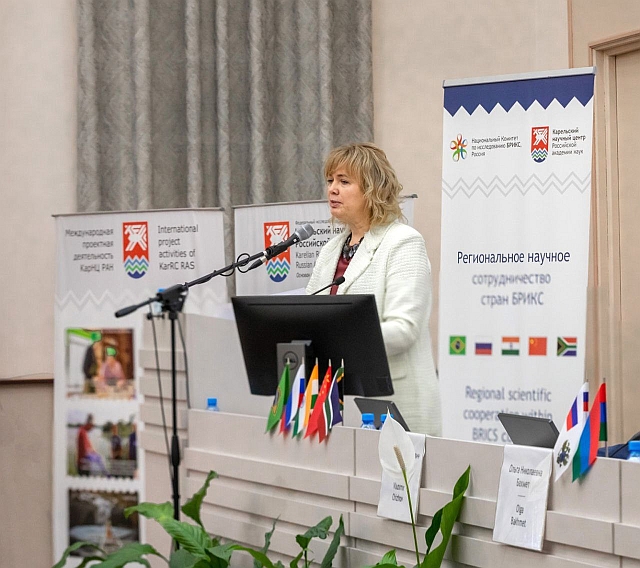
-- Understandably, significant changes have occurred in our relations with our traditional partners. In these circumstances, we have greatly expanded cooperation with our colleagues from the BRICS countries. These are India, China, Brazil, South Africa. One may say that the natural environments of these countries are quite different. Yet, science truly goes beyond borders.

-- What plans does the KarRC RAS have for this special year?
-- We have planned to organize a multitude of conferences, seminars, and expeditions, where we will continue to discuss our research areas and the development paths for the research centre. Scientists from other regions of Russia and the world will take part in this dialogue. The central event will be a major international conference scheduled for September. It’s going to be multidisciplinary, gathering specialists of diverse profiles. That is why this anniversary year is special and pivotal for deciding which scientific directions to develop in the future, among other things. Exchanging experiences with colleagues may trigger adjustments to some of our research areas and help advance in the existing ones, but in any case, it will allow us to look to the future with confidence.
In conclusion, I would like to once again congratulate my colleagues on the 80th anniversary of the Karelian Research Centre, wish them health, happiness, and, certainly, scientific achievements.